Technology · Programming Languages
Zig 0.16 Is Not Replacing C. It Is Making C Developers Realize They Deserve Better.
Zig 0.16 drops with async rewrite, improved comptime, and growing production adoption at Bun, TigerBeetle, and Uber. Why C developers should stop ignoring this language in 2026.

Anurag Verma
16 min read

Sponsored
Here is what nobody in the systems programming discourse wants to say out loud: C is not a good language. It is a familiar one. Generations of programmers have confused their hard-won muscle memory around undefined behavior, manual memory management, and header file gymnastics for some kind of virtue. And for decades, there was no credible alternative that did not ask you to adopt an entirely alien programming paradigm in exchange for safety. Rust tried. Rust succeeded, in many ways. But Rust also asked for a blood oath in the form of a borrow checker, and plenty of C developers looked at that contract and walked away.
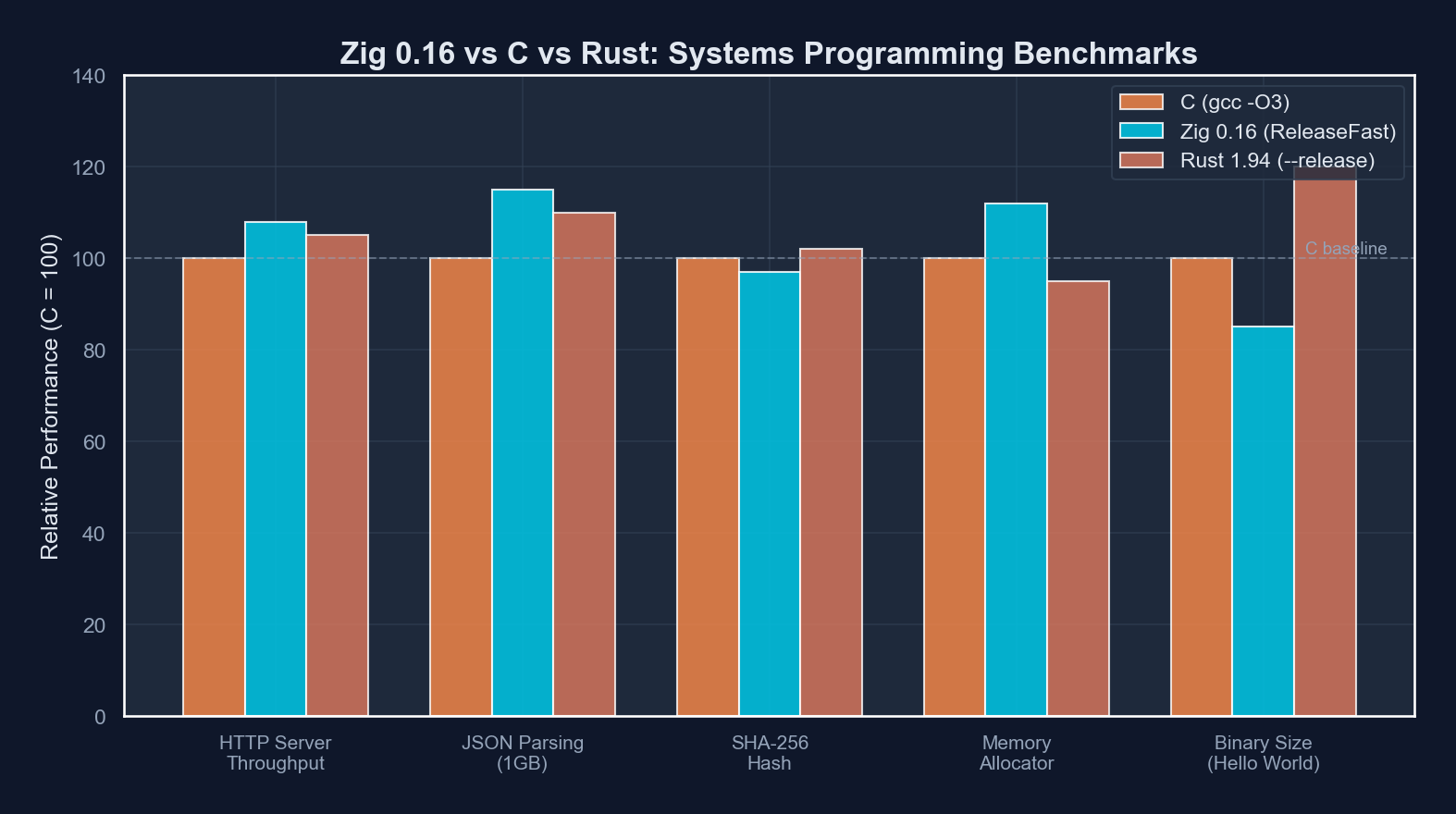
Zig 0.16, released in early 2026, is the strongest argument yet that you do not have to choose between C’s simplicity and modern safety guarantees. And the evidence is no longer theoretical — it is running in production at companies processing billions of requests.
Why Zig Exists (And Why You Should Care Now)
Andrew Kelley started Zig in 2015 with a deceptively simple thesis: what if we took everything C gets right — manual memory management, no hidden control flow, transparent performance characteristics — and removed everything it gets catastrophically wrong?
That sounds like the pitch for a dozen failed languages. What makes Zig different is discipline. Zig does not add features. It removes footguns. There is no operator overloading, no function overloading, no hidden allocations, no exceptions, no implicit type conversions. If you have ever spent three days debugging a C program only to discover that an implicit integer promotion silently corrupted your data, you already understand the appeal.
But philosophy does not ship software. Let us talk about what 0.16 actually brings to the table.
What Is New in Zig 0.16
The 0.16 release is one of the most significant in Zig’s history. The team has been working toward self-hosted compilation for years, and 0.16 represents major progress on that front alongside genuinely exciting language features.
The Async Rewrite
The headline feature is the complete overhaul of Zig’s async/await system. The previous implementation, present since 0.5, was tightly coupled to the compiler’s IR and had known issues with stack management in concurrent workloads. The 0.16 async model is built on top of Zig’s existing coroutine primitives and integrates cleanly with the I/O system.
const std = @import("std");

pub fn fetchData(allocator: std.mem.Allocator, url: []const u8) ![]u8 {
    var client = std.http.Client{ .allocator = allocator };
    defer client.deinit();

    var req = try client.open(.GET, try std.Uri.parse(url), .{
        .allocator = allocator,
    });
    defer req.deinit();

    try req.send();
    try req.wait();

    const body = try req.reader().readAllAlloc(allocator, 1024 * 1024);
    return body;
}

// In 0.16, you can now run these concurrently without
// the stack corruption issues from pre-0.16 async
pub fn main() !void {
    var gpa = std.heap.GeneralPurposeAllocator(.{}){};
    defer _ = gpa.deinit();
    const allocator = gpa.allocator();

    const urls = [_][]const u8{
        "https://api.example.com/data1",
        "https://api.example.com/data2",
    };

    var frames: [urls.len]@Frame(fetchData) = undefined;
    for (urls, 0..) |url, i| {
        frames[i] = async fetchData(allocator, url);
    }

    for (&frames) |*frame| {
        const result = try await frame;
        defer allocator.free(result);
        // Process result
    }
}
Compare that to the equivalent in C with libcurl and pthreads. I am not going to paste it here because it would take up half this article and still have at least two potential race conditions.
Improved Comptime: Zig’s Secret Weapon
If you only understand one thing about Zig, make it comptime. This is the feature that makes C macros look like cave paintings.
In C, metaprogramming means the preprocessor — a separate text-substitution language bolted onto the side of your actual language, with its own syntax, its own scoping rules, and absolutely no type safety. In C++, you get templates, which are Turing-complete in a way that makes everyone uncomfortable and nobody can debug.
Zig’s comptime is neither of these things. It is the same language. You write Zig. It runs at compile time. The types are the same. The semantics are the same. The error messages are comprehensible.
// Compile-time generic data structure -- not a macro, not a template.
// Just Zig code that runs before your binary exists.
fn Matrix(comptime T: type, comptime rows: usize, comptime cols: usize) type {
    return struct {
        data: [rows][cols]T,

        const Self = @This();

        pub fn init(value: T) Self {
            return .{ .data = .{.{value} ** cols} ** rows };
        }

        pub fn multiply(self: Self, other: Matrix(T, cols, rows)) Matrix(T, rows, rows) {
            var result = Matrix(T, rows, rows).init(0);
            for (0..rows) |i| {
                for (0..rows) |j| {
                    var sum: T = 0;
                    for (0..cols) |k| {
                        sum += self.data[i][k] * other.data[k][j];
                    }
                    result.data[i][j] = sum;
                }
            }
            return result;
        }
    };
}

// At compile time, this generates a specialized 4x4 float matrix
// with zero runtime overhead. No vtables. No type erasure.
const Mat4 = Matrix(f32, 4, 4);
In 0.16, comptime has been extended with better compile-time memory management, improved error reporting when comptime evaluation fails, and the ability to invoke more of the standard library at compile time. The practical result is that you can write more complex compile-time logic without hitting the artificial limits that plagued earlier versions.
 Zig’s comptime model: the same language at compile time and runtime, unlike C’s preprocessor or C++ templates
Build System Improvements
Zig’s build system has always been one of its underrated strengths. While C developers juggle CMake, Meson, autotools, and whatever unholy build script their project accumulated over twenty years, Zig uses… Zig. The build system is written in the same language you are already writing.
The 0.16 release brings dependency caching improvements that cut incremental build times significantly and better cross-compilation support. Zig can already cross-compile to over 40 targets out of the box — no separate toolchain installation required. In 0.16, the cross-compilation story for linking against system C libraries has improved substantially.
# Cross-compile from macOS to Linux ARM64 with one command.
# No Docker. No VM. No cross-toolchain setup.
zig build -Dtarget=aarch64-linux-gnu -Doptimize=ReleaseFast

# Use Zig as a drop-in C/C++ cross-compiler
zig cc -target x86_64-linux-musl -O2 legacy_code.c -o server
That last line is worth pausing on. Zig ships a fully functional C and C++ compiler. You can use it to compile your existing C codebases with better cross-compilation support than most dedicated C toolchains provide. This is not a gimmick — Uber uses it in production for exactly this purpose.
Real-World Adoption: Not Vaporware
The strongest rebuttal to any new language is “show me who’s using it.” Fair enough. Let us look at the evidence.
Production Zig in 2026
| Organization | Product/Use Case | Why They Chose Zig | Scale |
|---|---|---|---|
| Oven (Bun) | Bun JavaScript runtime | Performance-critical hot paths, C interop | Millions of npm installs/month |
| TigerBeetle | Financial transaction database | Deterministic performance, no hidden allocations | Processing millions of transactions |
| Uber | C/C++ cross-compilation toolchain | Zig’s C compiler for hermetic builds | Deployed across engineering org |
| Roc Lang | Compiler backend | Comptime for code generation | Open-source compiler |
| Mach Engine | Game engine and graphics | GPU programming, zero-overhead abstractions | Growing game dev community |
| Cloudflare | Internal tooling | WebAssembly compilation target | Edge computing infrastructure |
Bun: The Flagship
Bun is the proof point that matters most. Jarred Sumner chose Zig to build a JavaScript runtime that could compete with Node.js and Deno on performance. Bun’s HTTP server, bundler, transpiler, and package manager are all written in Zig. The results speak for themselves — Bun consistently benchmarks 3-5x faster than Node.js for common operations.
The fact that a single developer (initially) could build a production-quality JavaScript runtime in Zig — a language most developers have never heard of — says something profound about the language’s productivity. Zig is not a research language. It is a get-things-done language that happens to produce remarkably fast binaries.
TigerBeetle: Correctness at Scale
TigerBeetle might be the most ambitious Zig project in existence. It is a distributed financial database designed for correctness above all else. The team chose Zig specifically because of its transparent control flow — when you are handling other people’s money, you cannot afford hidden allocations, implicit copies, or surprise exceptions.
Their CEO, Joran Dirk Greef, has said publicly that Zig’s lack of hidden control flow is not just a nice-to-have for financial software — it is a requirement. Every allocation is visible. Every error must be handled. You cannot accidentally ignore a failure.
Zig vs. Rust: The Uncomfortable Comparison
Every Zig article eventually has to address the Rust-shaped elephant in the room. Let me be direct about this: Zig and Rust solve overlapping problems with fundamentally different philosophies, and pretending otherwise does a disservice to both.
Philosophy Comparison
| Dimension | Zig | Rust |
|---|---|---|
| Safety model | Runtime safety checks in debug, removable in release | Compile-time ownership and borrow checking |
| Learning curve | Moderate (familiar to C developers) | Steep (new mental model required) |
| Metaprogramming | comptime (same language) | Procedural macros (separate compile step) |
| Error handling | Error unions with explicit handling | Result type with ? operator |
| Memory management | Manual with allocator-passing convention | Ownership system with RAII |
| Hidden control flow | None by design | Deref coercions, Drop trait, implicit moves |
| C interop | First-class (shares ABI, imports headers directly) | Through FFI with unsafe blocks |
| Compile times | Fast | Notoriously slow for large projects |
| Ecosystem maturity | Small but growing | Large and established |
| Undefined behavior | Possible but explicitly marked | Prevented in safe code |
Rust fans will point out — correctly — that Rust prevents entire categories of bugs at compile time that Zig allows you to write. Use-after-free, data races, iterator invalidation: Rust catches these before your code ever runs. Zig does not.
But here is the contrarian take that the Rust community does not want to hear: compile-time guarantees have a cost that is not measured in benchmarks. That cost is cognitive overhead, compile times, and the sheer difficulty of expressing certain patterns that are trivial in C-like languages.
Have you ever tried to write a doubly-linked list in Rust? It is a rite of passage that involves either unsafe blocks or reaching for Rc<RefCell<T>> — a pattern that gives you runtime borrow checking, which is exactly what Zig gives you by default but without the ceremony.
// Doubly-linked list in Zig: straightforward, no ceremony
const std = @import("std");

const Node = struct {
    data: i32,
    prev: ?*Node,
    next: ?*Node,
};

fn insertAfter(node: *Node, new_node: *Node) void {
    new_node.prev = node;
    new_node.next = node.next;
    if (node.next) |next| {
        next.prev = new_node;
    }
    node.next = new_node;
}
Compare that to the equivalent safe Rust implementation, which requires either unsafe or a reference-counting wrapper. The Zig version is not just simpler — it is the code you would write if you sat down with a whiteboard and designed a linked list from first principles. Zig does not make you fight the language to express data structures with complex ownership graphs.
 Two paths to safety: Rust enforces it at compile time, Zig makes dangerous operations explicit and visible
Where Rust Wins
I am not going to pretend this is a clean sweep for Zig. Rust has genuine advantages:
- Ecosystem: crates.io has over 150,000 packages. Zig’s package ecosystem is nascent.
- Fearless concurrency: Rust’s type system genuinely prevents data races. Zig does not.
- Industry adoption: Rust is in the Linux kernel. Zig is not (yet).
- Hiring: Finding Rust developers is hard. Finding Zig developers is harder.
The right choice depends on your constraints. If you are building safety-critical software and can afford the learning curve and compile times, Rust remains the gold standard. If you are a C developer who wants a better C without adopting a fundamentally different programming paradigm, Zig is the answer.
Why C Developers Specifically Should Pay Attention
Here is the pitch for the C developer who has been doing this for twenty years and is skeptical of every new language that promises to replace their tools.
You Already Know Most of Zig
Zig’s semantics are deliberately close to C’s. You have manual memory management. You have pointers (though Zig’s are more type-safe). You have structs, enums, unions. The control flow is explicit. There is no garbage collector, no runtime, no hidden magic.
The differences are additions, not replacements:
- Optional types instead of null pointers:
?*Nodeinstead ofNode*that might be null - Error unions instead of errno:
!voidmeans “this function returns void or an error” - Slices instead of pointer-plus-length:
[]u8carries its length with it - Comptime instead of the preprocessor: generic programming in the actual language
C Interop Is Not an Afterthought
Most “C replacement” languages treat C interop as a bridge you hold your nose while crossing. Zig treats it as a first-class feature. Zig can directly @cImport C header files and call C functions without writing bindings. It can link against C libraries. It can be called from C. It shares the C ABI.
const c = @cImport({
    @cInclude("sqlite3.h");
});

pub fn openDatabase(path: [*:0]const u8) !*c.sqlite3 {
    var db: ?*c.sqlite3 = null;
    const rc = c.sqlite3_open(path, &db);
    if (rc != c.SQLITE_OK) {
        return error.SqliteError;
    }
    return db.?;
}
No bindings generator. No FFI declarations. No unsafe blocks. You include the header and call the function. For teams with large C codebases, this means you can adopt Zig incrementally — new modules in Zig, existing modules in C, all in the same build.
The Safety Argument: Zig’s Middle Path
The systems programming safety debate has been polarized into two camps: “just use Rust” and “C is fine, skill issue.” Zig offers a third position that both camps find uncomfortable.
Zig includes runtime safety checks — bounds checking on arrays, null checks on optionals, detection of undefined behavior — that are enabled in debug and test builds. In release builds, you can disable them for performance-critical sections. This is the same approach that every competent C developer already uses with assertions, except it is built into the language rather than bolted on with macros.
Is this as safe as Rust? No. The compiler does not prove the absence of memory bugs at compile time. But it catches a remarkable number of them at development time, and it does so without requiring you to restructure your code around an ownership model.
The pragmatic question is not “which language is safer in theory?” but “which language will result in fewer bugs in my codebase, given my team’s skills and constraints?” For a team of experienced C developers, the answer might genuinely be Zig — not because Zig is theoretically safer than Rust, but because the team will actually use Zig’s safety features instead of fighting them.
What Is Holding Zig Back
Intellectual honesty requires acknowledging the real obstacles:
-
Pre-1.0 status. Breaking changes between releases are a legitimate concern for production users. The Zig team has been transparent about the roadmap, but “we will break your code” is a hard sell for risk-averse organizations.
-
Ecosystem size. The package ecosystem is small. You will write more code from scratch or wrap C libraries. For some teams, this is a dealbreaker. For others — particularly those already wrapping C libraries anyway — it is a non-issue.
-
IDE support. ZLS (Zig Language Server) has improved substantially, but it is not at the level of rust-analyzer or clangd. Autocomplete, refactoring tools, and debugging integration are all weaker than what you get with established languages.
-
Documentation. The standard library documentation is auto-generated and sparse. You will read source code more often than docs. This is the kind of problem that solves itself as the community grows, but right now it is a friction point.
-
Hiring. Good luck putting “3+ years of Zig experience” in a job posting. The talent pool is small, and training costs are real.
The Verdict: Should You Learn Zig in 2026?
If you write C for a living, yes. Not because Zig is going to replace C overnight — it will not — but because Zig will change how you think about the trade-offs you have been accepting as inevitable. Optional types will make you question why you ever tolerated null pointer dereferences. Comptime will make you wonder why you spent years wrestling with the C preprocessor. The build system will make you ask why CMake is the way it is.
If you write Rust, Zig is worth understanding but probably not worth switching to. Rust’s safety guarantees are genuine and valuable. Zig trades some of those guarantees for simplicity and C interop, and that trade-off may or may not make sense for your work.
If you write Go, Java, or Python and are curious about systems programming, Zig is arguably a better starting point than either C or Rust. It is simpler than Rust, more modern than C, and the comptime system will teach you more about how programming languages work than any textbook.
Zig 0.16 is not the release that replaces C. No single release will be. But it is the release that makes the trajectory undeniable: a language designed by people who genuinely love C but refuse to pretend its flaws are features. That is a rare and valuable thing in a field that oscillates between “move fast and break things” and “we have always done it this way.”
The C developers who dismiss Zig are making the same mistake the assembly programmers made about C in the 1970s. Not that their language is dying — but that nothing better could possibly exist.
Sponsored
More from this category
More from Technology
 R.01
R.01 DuckDB in Practice: Analytical Queries Without a Data Warehouse
 R.02
R.02 The Modern Developer's Local Tooling in 2026: Terminal, Git, and the Productivity Stack
 R.03
R.03 Product Analytics for Developer Teams: PostHog vs Mixpanel vs Amplitude in 2026
Sponsored
Discussion
Join the conversation.
Comments are powered by GitHub Discussions. Sign in with your GitHub account to leave a comment.
Sponsored