AI Integration · Industry News
OpenAI Is Retiring GPT-4o on February 13 — The End of an Era for ChatGPT's Most Beloved Model
OpenAI is retiring GPT-4o, GPT-4.1, GPT-4.1 mini, and o4-mini from ChatGPT on February 13, 2026. Only 0.1% of users still choose GPT-4o daily, but the model's retirement marks the end of the GPT-4 generation.

Anurag Verma
5 min read

Sponsored
On February 13, 2026, OpenAI will retire GPT-4o, GPT-4.1, GPT-4.1 mini, and o4-mini from ChatGPT. The company previously announced the retirement of GPT-5 (Instant and Thinking variants) on the same date. After February 13, all ChatGPT users will be on GPT-5.2.
The announcement, made on January 29, gave users just two weeks of notice, though the reaction has been considerably more muted than last year’s botched deprecation attempt.

What Is Being Retired
| Model | Status | Retirement Date |
|---|---|---|
| GPT-4o | Active → Retiring | February 13, 2026 |
| GPT-4.1 | Active → Retiring | February 13, 2026 |
| GPT-4.1 mini | Active → Retiring | February 13, 2026 |
| o4-mini | Active → Retiring | February 13, 2026 |
| GPT-5 (Instant) | Previously announced | February 13, 2026 |
| GPT-5 (Thinking) | Previously announced | February 13, 2026 |
| GPT-5.2 | Current default | Remains |
After February 13, GPT-4o will no longer appear in the model dropdown. Existing chats and custom GPTs will automatically default to GPT-5.2. Chat history will remain saved but the model cannot be reselected.
Importantly, the API is not affected. These changes only apply to the ChatGPT consumer product.
The GPT-4o Story
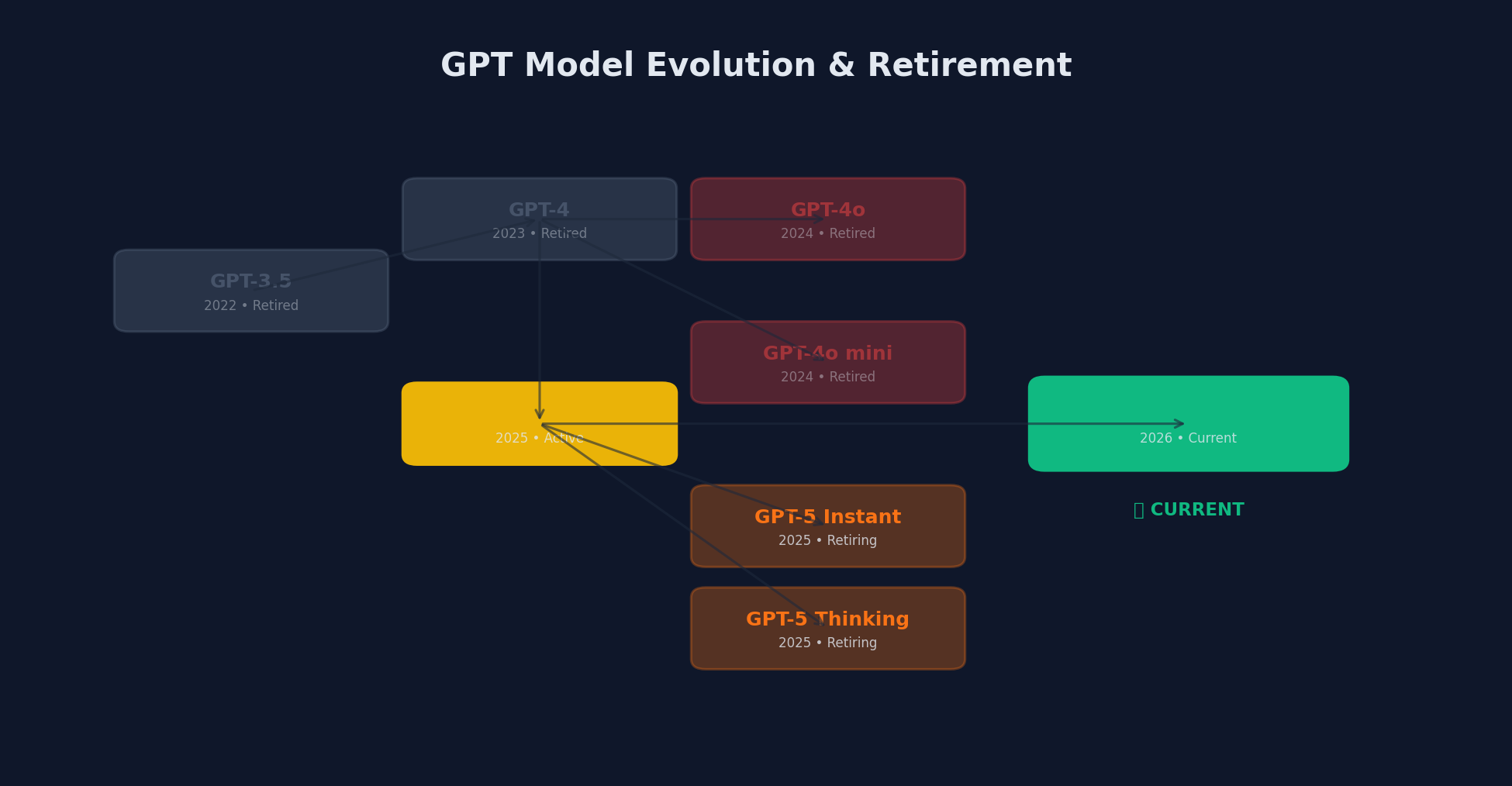 The GPT model evolution: from GPT-3.5 through the GPT-4o era to GPT-5.2 consolidation
GPT-4o launched in May 2024 and quickly became one of OpenAI’s most popular models. Its warm, conversational tone and creative capabilities earned it a dedicated following among ChatGPT Plus and Pro users.
The model’s popularity became a problem for OpenAI in August 2025, when the company briefly removed access to GPT-4o following the launch of GPT-5. The backlash was immediate and intense. Users protested the loss of GPT-4o’s personality, and CEO Sam Altman personally intervened, restoring access for paid users and pledging to give “plenty of notice” before any future retirement.
OpenAI says feedback from GPT-4o loyalists directly shaped the development of GPT-5.1 and GPT-5.2, particularly in the areas of personality, creativity, and conversational warmth.
Why Now
OpenAI’s reasoning is straightforward: usage has shifted. Only 0.1% of daily ChatGPT users still choose GPT-4o. The vast majority have migrated to GPT-5.2, which OpenAI describes as superior across all benchmarks.
Maintaining multiple model versions consumes compute resources and engineering bandwidth. With usage this low, the operational cost of keeping GPT-4o running outweighs the benefit to the small number of remaining users.
The Broader Pattern: Model Consolidation
OpenAI’s decision to retire six models simultaneously reflects a broader industry trend toward model consolidation:
OpenAI Model Timeline
├── 2023: GPT-3.5, GPT-4 (2 main models)
├── 2024: GPT-4, GPT-4o, GPT-4 Turbo, o1, o1-mini (5+ models)
├── 2025: GPT-4o, GPT-4.1, GPT-5, o3, o4-mini (6+ models)
└── 2026: GPT-5.2 (consolidating to 1 main model)
The pattern is clear: rapid model proliferation followed by aggressive consolidation. This suggests OpenAI is moving toward a single, unified model architecture (GPT-5.2) rather than maintaining specialized variants for different use cases.
Other AI companies are following a similar path. Anthropic consolidated from Claude 3 Haiku, Sonnet, and Opus to a unified Claude 4 architecture. Google streamlined its Gemini model lineup.
What This Means for Developers
For developers building on the ChatGPT platform:
1. Custom GPTs will migrate automatically. If you built a custom GPT using GPT-4o or GPT-4.1, it will switch to GPT-5.2 after February 13. Test your GPTs with GPT-5.2 before the cutover to ensure consistent behavior.
2. API is unaffected, for now. The API retains access to older models, but the ChatGPT deprecation is likely a preview of future API changes. If your production systems depend on GPT-4o via the API, start planning migration.
3. Personality differences matter. GPT-4o and GPT-5.2 have different conversational styles. If your application depends on specific tonal qualities, verify that GPT-5.2 meets your requirements.
4. Prompt behavior changes. Different model versions respond differently to the same prompts. Prompts optimized for GPT-4o may produce different results on GPT-5.2. Run regression tests on critical prompts.
Ongoing Improvements
OpenAI has committed to several near-term improvements to GPT-5.2:
- Better personality and creativity. Directly addressing the qualities that made GPT-4o popular.
- Reduced unnecessary refusals. Fewer cases where the model refuses reasonable requests.
- Less preachy responses. Addressing user complaints about overly cautious or moralizing outputs.
- Adult-oriented version. A version designed for users over 18, “grounded in the principle of treating adults like adults”.
These improvements suggest OpenAI is listening to the feedback that emerged from the GPT-4o loyalty phenomenon.
The End of an Era
GPT-4o’s retirement marks the end of the GPT-4 generation. When GPT-4 launched in March 2023, it was a breakthrough moment for AI. Three years later, the entire model family is being sunset in favor of its successor.
The speed of this transition shows how quickly AI capabilities are advancing. Models that were state-of-the-art 18 months ago are now obsolete. For anyone building on top of these models (applications, businesses, or workflows), the lesson is clear: build for adaptability, not for specific model versions.
Sponsored
More from this category
More from AI Integration
 R.01
R.01 Document AI for Agencies: Extracting Structure from PDFs, Forms, and Contracts
R.02 AI Video Generation in 2026: What Agencies Need to Know Before Pitching It to Clients
 R.03
R.03 Browser-Use Agents: Automating the Web When APIs Don't Exist
Sponsored
Discussion
Join the conversation.
Comments are powered by GitHub Discussions. Sign in with your GitHub account to leave a comment.
Sponsored